
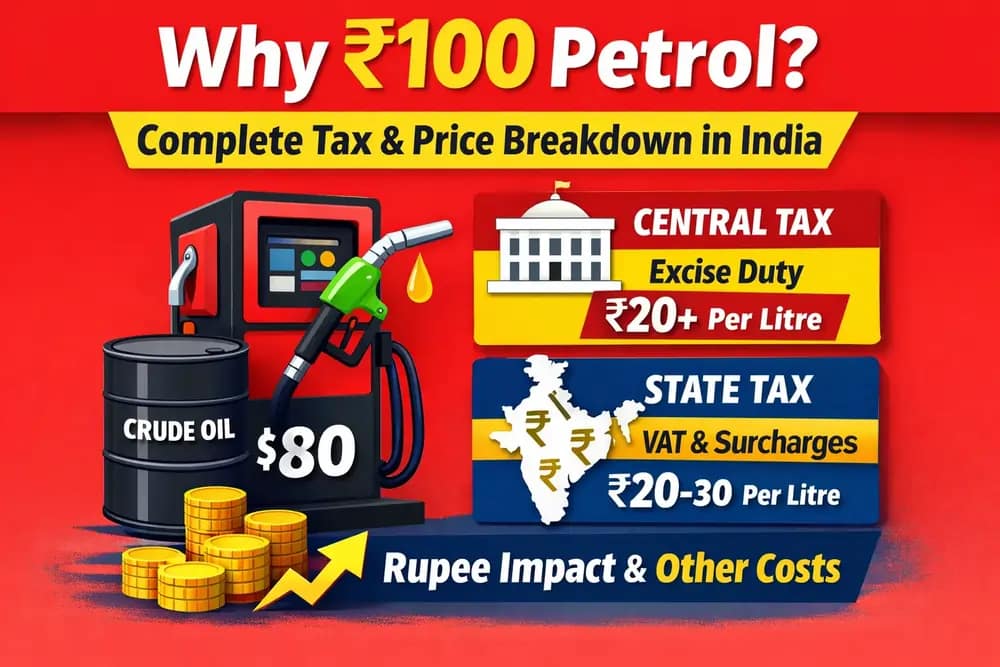
Petrol Price Breakup in India: Why ₹100 Petrol Is Still So Expensive?
Petrol and diesel prices hovering near ₹100 per litre have become a daily concern for Indian households. Every visit to the petrol pump raises the same question—why is petrol so expensive in India even when global crude oil prices fall?
The simple truth is that the high price of petrol is driven more by taxes and policy decisions than by the actual cost of crude oil. A large portion of what consumers pay goes directly to the Central and State Governments in the form of excise duty and VAT. This article explains in detail why petrol and diesel are so expensive in India, how fuel prices are calculated, and why ₹100 petrol has become the new normal.
Petrol Price Breakup in India
Most people assume petrol is expensive because oil companies charge more. In reality, more than half of the petrol price is tax.
₹100 Petrol Price Breakup (Approximate)
| Component | Amount (₹ per litre) |
|---|---|
| Crude oil cost | 30 – 35 |
| Refining cost | 4 – 6 |
| Freight and logistics | 3 – 4 |
| Central excise duty | 19 – 21 |
| State VAT | 20 – 25 |
| Dealer commission | 3 – 4 |
| Final pump price | ₹95 – ₹105 |
This clearly shows that around 50–60% of the petrol price in India is tax, not the cost of fuel itself.
Why Petrol Price Is High in India
Heavy taxation by governments
The biggest reason petrol is expensive in India is the heavy taxation imposed by both the Central and State Governments. The Centre charges excise duty per litre, while states levy Value Added Tax (VAT). Together, these taxes often exceed the base cost of crude oil.
Why Petrol Is Not Under GST
Petrol and diesel are kept outside the Goods and Services Tax (GST) system. This allows the Centre and states to charge their own taxes without any upper limit.
If petrol were brought under GST, the tax rate would be capped at 28 percent, which could reduce petrol prices by ₹15 to ₹25 per litre. However, fuel taxes are a major revenue source for governments, making inclusion under GST politically and economically difficult.
Why Petrol Prices Do Not Fall When Crude Oil Becomes Cheaper
When international crude oil prices decline, consumers expect petrol prices to fall. However, governments often increase or maintain excise duty during such periods. This strategy acts as a tax buffer, allowing governments to protect their revenues instead of passing on the full benefit to consumers.
As a result, lower crude prices rarely translate into cheaper petrol at the pump.
India’s Dependence on Imported Crude Oil
India imports nearly 80–85 percent of its crude oil requirement. This makes petrol and diesel prices highly sensitive to global factors such as:
-
OPEC production decisions
-
Geopolitical tensions and wars
-
Global supply disruptions
-
Changes in international demand
Any instability in global markets directly affects fuel prices in India.
Impact of USD–INR Exchange Rate on Petrol Prices
Crude oil is traded internationally in US dollars. When the Indian Rupee weakens against the dollar, the cost of importing crude oil rises. Even if crude oil prices remain stable globally, a weak rupee increases the domestic cost of petrol and diesel.
This currency impact is one of the hidden reasons petrol prices remain high in India.
Simple Example to Understand (Per-Litre Impact)
Assume the international crude oil price is $80 per barrel.
One barrel of crude oil ≈ 159 litres
However, one barrel does not become 159 litres of petrol. After refining, it produces multiple products like petrol, diesel, LPG, ATF, etc.
Average yield from one barrel (approx.):
-
Petrol: 45–50 litres
-
Diesel: 35–40 litres
-
Other products (LPG, ATF, bitumen, etc.): remaining quantity
Case 1: When the Rupee Is Strong
-
USD–INR rate: ₹75 per dollar
-
Cost of crude oil:
$80 × ₹75 = ₹6,000 per barrel
Approximate cost per litre of crude:
-
₹6,000 ÷ 159 litres ≈ ₹37.7 per litre
Crude cost per litre of petrol (before tax & refining):
-
₹6,000 ÷ 48 litres (avg petrol output) ≈ ₹125 per litre (crude allocation basis)
Case 2: When the Rupee Weakens
-
USD–INR rate: ₹83 per dollar
-
Cost of crude oil:
$80 × ₹83 = ₹6,640 per barrel
Approximate cost per litre of crude:
-
₹6,640 ÷ 159 litres ≈ ₹41.7 per litre
Crude cost per litre of petrol (before tax & refining):
-
₹6,640 ÷ 48 litres ≈ ₹138 per litre (crude allocation basis)
Refining, Transport and Dealer Costs
Apart from crude oil and taxes, petrol prices also include:
-
Refining and processing charges
-
Transportation through pipelines and tankers
-
Storage at oil depots
-
Fixed dealer commission per litre
Oil Marketing Companies operate on relatively thin margins, and their profits are a small part of the final retail price.
Refining, transport, and dealer costs add ₹10–₹12 per litre even before taxes are applied. When combined with high excise duty and VAT, the final petrol price easily crosses ₹100 per litre.
This is why petrol prices remain high even when global crude prices are stable or falling.
Why Petrol Prices Differ Across States
Petrol prices vary from city to city because state VAT rates are different. Since petrol is not under GST, states have full control over VAT, leading to regional price differences.
Petrol Prices in Major Cities (Approximate – January 2026)
| City | Petrol price (₹ per litre) |
|---|---|
| New Delhi | ~₹94.77 |
| Mumbai | ~₹103.50 – ₹103.54 |
| Pune | ~₹104.03 – ₹104.29 |
| Noida | ~₹94.77 – ₹94.88 |
| Patna | ~₹106.11 |
Cities in states such as Maharashtra and Bihar generally have higher petrol prices due to higher VAT rates.
Petrol Price Trend: Last 6 Months
Despite changes in global crude oil prices, petrol prices in India have remained largely stable at high levels due to unchanged taxes.
| City | Aug 2025 | Sep 2025 | Oct 2025 | Nov 2025 | Dec 2025 | Jan 2026 |
|---|---|---|---|---|---|---|
| New Delhi | 94.5 | 94.6 | 94.7 | 94.8 | 94.8 | 94.77 |
| Mumbai | 103.2 | 103.3 | 103.4 | 103.5 | 103.5 | 103.54 |
| Pune | 103.8 | 103.9 | 104.0 | 104.1 | 104.2 | 104.29 |
| Noida | 94.6 | 94.7 | 94.8 | 94.8 | 94.9 | 94.88 |
| Patna | 105.7 | 105.8 | 105.9 | 106.0 | 106.1 | 106.11 |

Why Petrol Prices Change Daily in India
India follows a dynamic fuel pricing system. Petrol and diesel prices are revised daily at 6:00 AM based on international crude oil prices and currency exchange rates. This ensures price alignment with global markets, though taxes keep retail prices elevated.
Also Read :-https://gstandtax.com/gold-silver-taxation-in-india-2026-buying-selling/
How to Check Petrol and Diesel Prices by SMS
Consumers can check fuel prices in their city by sending an SMS.
Format:
RSP <space> Dealer Code
Send to 92249 92249
Dealer codes are displayed at petrol pumps. Prices received by SMS are indicative and may vary slightly between outlets.
For further assistance, consumers can call the toll-free number 1800-2333-555.
Impact of High Petrol Prices on Common People
High petrol and diesel prices affect more than just vehicle owners. They increase transportation costs, raise prices of essential goods, increase business expenses, and reduce the real purchasing power of salaried and middle-class families.
Conclusion: Why ₹100 Petrol Is the New Normal in India
Petrol and diesel are expensive in India primarily due to heavy taxation by Central and State Governments, exclusion from GST, dependence on imported crude oil, currency fluctuations, and government reliance on fuel taxes for revenue.
More than half of what consumers pay for petrol goes towards taxes rather than the actual fuel. Until fuel taxation is rationalised or petrol is brought under GST, ₹100 petrol is likely to remain a long-term reality in India.
1 thought on “Petrol Price Breakup in India: Why ₹100 Petrol Is Still So Expensive? (Tax Explained)”