
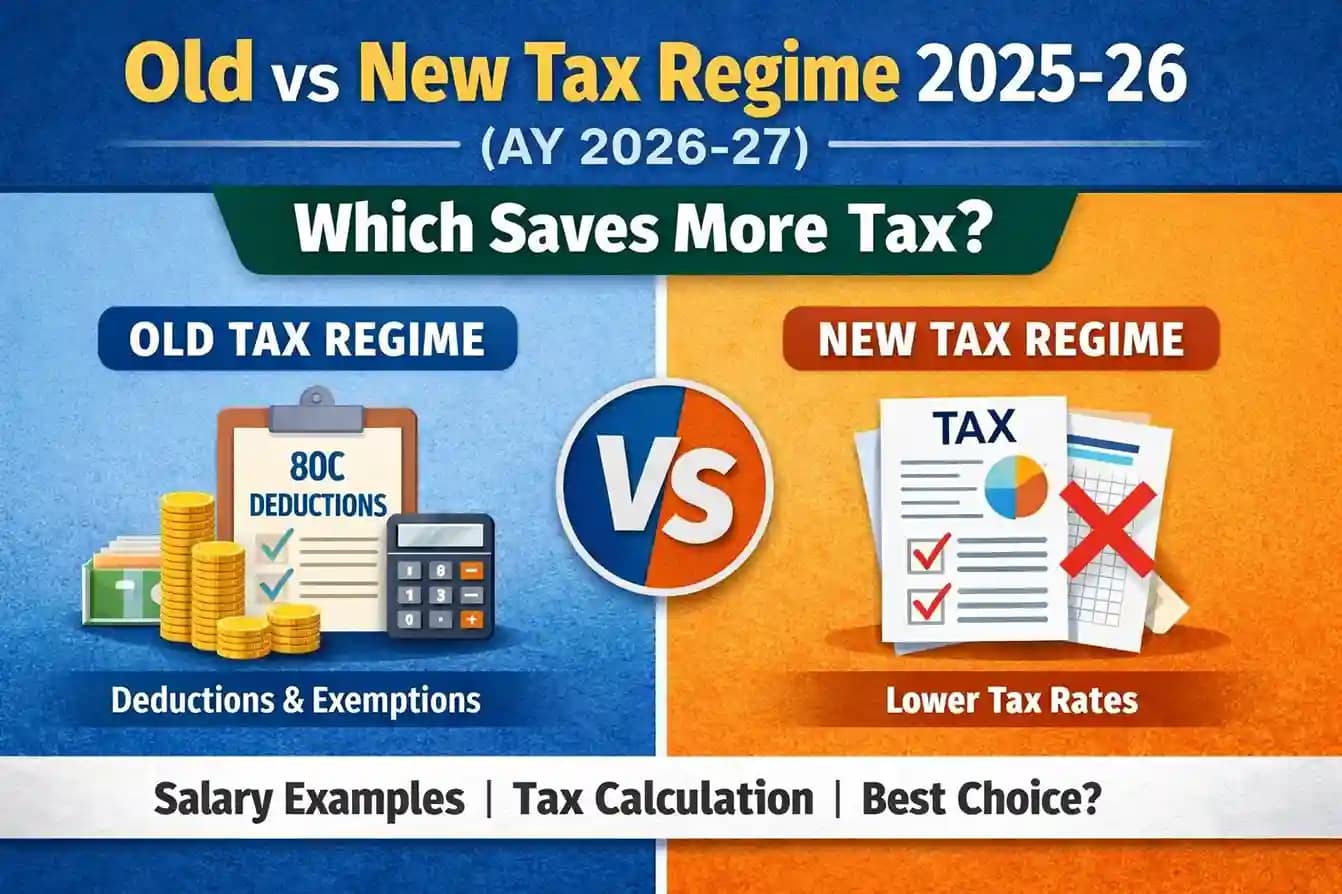
Old vs New Tax Regime 2025-26 (AY 2026-27): Which One Saves More Tax?
Choosing between the old tax regime and the new tax regime has become one of the most confusing decisions for Indian taxpayers. Every year, salaried employees, freelancers, and small business owners ask the same question:
Which tax regime is better in AY 2026-27?
In this detailed guide, we will compare Old vs New Tax Regime 2025-26 (AY 2026-27) using clear tables, salary calculation examples, deductions, and practical scenarios so that you can choose the option that actually saves more tax, not just looks attractive on paper.
Understanding Old vs New Tax Regime 2025-26
Before comparing numbers, let’s understand the basic difference.
Old Tax Regime
-
Allows multiple deductions and exemptions
-
Best for people who actively invest in tax-saving instruments
-
More paperwork, but potentially lower tax
New Tax Regime
-
Lower tax slab rates
-
Very limited deductions
-
Simple and clean, but not always cheaper
This is why blindly choosing the new regime can sometimes increase your tax, especially for salaried employees.
Income Tax Slabs for FY 2025-26 (AY 2026-27)
New Tax Regime Slabs (FY 2025-26)
| Income Slab | Tax Rate |
|---|---|
| Up to ₹3,00,000 | Nil |
| ₹3,00,001 – ₹6,00,000 | 5% |
| ₹6,00,001 – ₹9,00,000 | 10% |
| ₹9,00,001 – ₹12,00,000 | 15% |
| ₹12,00,001 – ₹15,00,000 | 20% |
| Above ₹15,00,000 | 30% |
Standard deduction in new tax regime 2025 is allowed for salaried employees.
Old Tax Regime Slabs
| Income Slab | Tax Rate |
|---|---|
| Up to ₹2,50,000 | Nil |
| ₹2,50,001 – ₹5,00,000 | 5% |
| ₹5,00,001 – ₹10,00,000 | 20% |
| Above ₹10,00,000 | 30% |
Old Tax Regime Deductions List 2025
This is where the old regime shines.
Common deductions available:
-
Section 80C (₹1.5 lakh – PPF, LIC, ELSS, etc.)
-
Section 80D (Health insurance)
-
HRA exemption
-
LTA
-
Home loan interest (Section 24)
-
Standard deduction
If you use even 2–3 of these properly, the old regime can beat the new one easily.
Old vs New Tax Regime Salary Calculation Example
Let’s answer the most searched question:
Which tax regime is better for salaried employees 2025?
Example 1: ₹6 Lakh Salary
| Particulars | Old Regime | New Regime |
|---|---|---|
| Gross Salary | ₹6,00,000 | ₹6,00,000 |
| Deductions | ₹1,50,000 | ₹50,000 |
| Taxable Income | ₹4,50,000 | ₹5,50,000 |
| Tax Payable | Nil | ~₹12,500 |
Winner: Old Tax Regime
Example 2: Old Tax Regime vs New Tax Regime for ₹10 Lakh Salary
| Particulars | Old Regime | New Regime |
|---|---|---|
| Gross Salary | ₹10,00,000 | ₹10,00,000 |
| Total Deductions | ₹2,50,000 | ₹50,000 |
| Taxable Income | ₹7,50,000 | ₹9,50,000 |
| Tax Payable (approx) | ₹52,500 | ₹67,500 |
Winner: Old Tax Regime
This clearly shows why old vs new tax regime with examples is the only correct way to decide.
Example 3: Old Tax Regime vs New Tax Regime for ₹15 Lakh Salary
| Particulars | Old Regime | New Regime |
|---|---|---|
| Gross Salary | ₹15,00,000 | ₹15,00,000 |
| Total Deductions | ₹4,25,000 | ₹50,000 |
| Taxable Income | ₹10,75,000 | ₹14,50,000 |
| Tax Payable (approx) | ₹1,51,000 | ₹1,45,000 |
Assumptions (Old Regime):
-
80C investment: ₹1,50,000
-
Health insurance (80D): ₹25,000
-
Home loan interest: ₹2,00,000
-
Standard deduction: ₹50,000
Winner: Depends on deductions
If you fully utilise deductions like home loan + 80C, the Old Tax Regime remains competitive.
If you don’t have major deductions, the New Tax Regime saves slightly more tax.
New Tax Regime vs Old Tax Regime Calculation – Who Should Choose What?
Choose Old Tax Regime if:
-
You claim HRA
-
You invest in 80C
-
You have home loan or insurance
-
You are a disciplined saver
Choose New Tax Regime if:
-
You don’t want paperwork
-
No major deductions
-
Simple salary structure
Also Read:-https://gstandtax.com/income-tax-on-share-trading-in-india-rules-itr/

Which Tax Regime Is Better in AY 2026-27?
There is no single answer.
-
For most salaried employees, the old tax regime is still better
-
For freshers or people with no deductions, the new regime may work
This is why searching “which tax regime is better in ay 2026-27” has become so common.
New Tax Regime Benefits and Drawbacks
Benefits
-
Simple compliance
-
Lower slab rates
-
No investment pressure
Drawbacks
-
Very few deductions
-
No HRA or major exemptions
-
Can result in higher tax for middle-income earners
Can We Switch Between Old and New Tax Regime?
Yes, but with conditions:
-
Salaried employees can switch every year
-
Business income taxpayers get only one chance
So choose carefully if you run a business.
FAQs – People Also Ask
Is new tax regime mandatory in 2025?
No. You can still choose the old regime.
Is standard deduction allowed in new tax regime?
Yes, standard deduction in new tax regime 2025 is allowed for salaried employees.
Which tax regime is better for ₹15 lakh salary?
Depends on deductions. With investments → old regime. Without → new regime.
Can salaried employees choose old tax regime every year?
Yes, they can switch every year.
Final Verdict: Which One Saves More Tax?
Don’t choose based on slabs. Choose based on your life.
-
If you invest and plan → Old Tax Regime
-
If you want simplicity → New Tax Regime
Always do a proper old vs new tax regime calculation before filing your return.
Pro Tip
Before filing ITR for AY 2026-27, do one manual calculation or consult a tax expert. A wrong choice can cost you ₹20,000–₹50,000 extra tax every year.
1 thought on “Old vs New Tax Regime 2025-26 (AY 2026-27): Which One Saves More Tax?”