
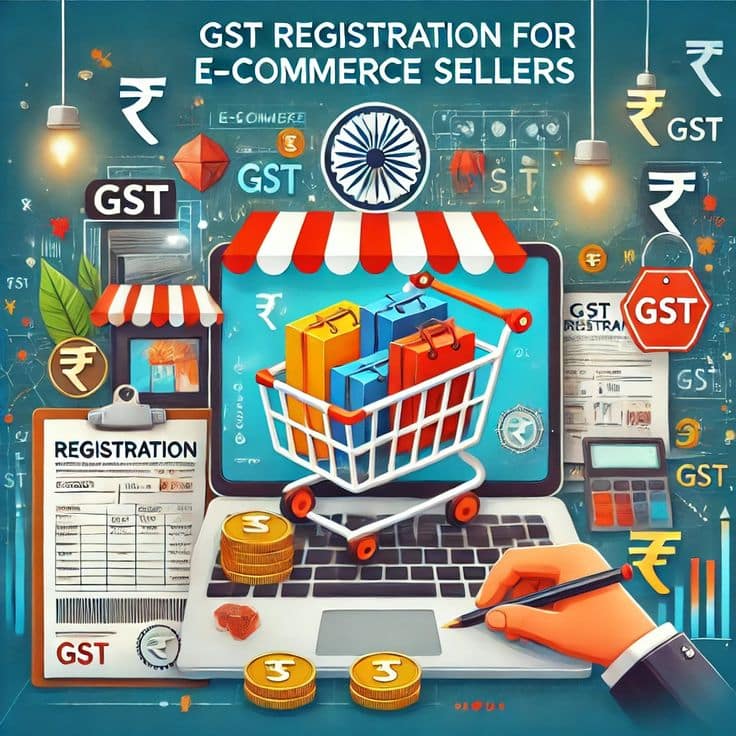
GST on E-Commerce Sellers – Compliance & Challenges
The rise of e-commerce in India has opened new opportunities for small businesses, startups, and entrepreneurs. Platforms like Amazon, Flipkart, Meesho, and Shopify have made it easier for sellers to reach customers across the country. However, selling online comes with a responsibility – complying with Goods and Services Tax (GST) regulations.
E-commerce sellers often face confusion about GST registration, return filing, tax collection at source (TCS), and other compliance requirements. In this blog, we will explain the GST rules for e-commerce sellers, compliance requirements, and common challenges they face.
GST Applicability on E-Commerce Sellers
Under GST law, any person selling goods or services through an e-commerce platform must register under GST, irrespective of turnover (except in cases where exemption is specifically provided).
✅ Key Rules for E-Commerce Sellers:
-
Mandatory GST Registration: Sellers on platforms like Amazon, Flipkart, and others must obtain a GSTIN even if turnover is below ₹40 lakh (for goods) or ₹20 lakh (for services).
-
Tax Collection at Source (TCS):
-
E-commerce operators (ECOs) are required to deduct TCS at 1% (0.5% CGST + 0.5% SGST or 1% IGST) from sellers.
-
The deducted amount is reflected in the seller’s GST portal and can be claimed while filing returns.
-
-
GST on Services: Service providers such as cab aggregators, food delivery apps, and freelancers working through online platforms also come under GST regulations.
Compliance Requirements for E-Commerce Sellers
To remain compliant under GST, e-commerce sellers must follow these steps:
-
GST Registration
-
Obtain a GSTIN before selling online.
-
Registration is mandatory regardless of turnover (except in notified exempt cases).
-
-
Issuing GST Invoices
-
Every sale must be accompanied by a proper GST invoice with HSN/SAC codes.
-
-
Filing GST Returns
-
GSTR-1: Monthly/quarterly return for outward supplies.
-
GSTR-3B: Monthly return for tax payment.
-
Annual return (GSTR-9), if applicable.
-
-
TCS Compliance
-
Sellers must reconcile TCS deducted by the e-commerce operator with the details available in the GST portal.
-
-
Maintaining Proper Records
-
Sellers should maintain digital invoices, purchase records, and reconciliation statements to avoid notices from tax authorities.
-
Challenges Faced by E-Commerce Sellers
While GST has streamlined taxation, e-commerce sellers face unique challenges:
❌ 1. Mandatory GST Registration
Even small sellers with low turnover need GST registration if selling online, which increases compliance costs.
❌ 2. Complex Return Filing
Sellers must file multiple returns and reconcile invoices, TCS deductions, and sales records – a time-consuming task.
❌ 3. Cash Flow Issues due to TCS
Since 1% TCS is deducted upfront, sellers face reduced working capital, impacting small businesses.
❌ 4. State-Wise Supply Rules
E-commerce involves inter-state sales, meaning sellers must follow IGST rules and proper classification of goods/services.
❌ 5. Risk of Penalties
Non-compliance with GST filing, wrong HSN codes, or mismatch in TCS reconciliation may lead to penalties and notices.
Benefits of GST for E-Commerce
Despite challenges, GST has also brought benefits for e-commerce sellers:
-
Unified Taxation: Eliminated multiple state-level taxes (VAT, CST, service tax).
-
Nationwide Market: Easier to sell across states without tax barriers.
-
Improved Transparency: Automated record of sales and tax credits.
-
Boost to Digital Business: Encourages startups and small sellers to expand online.
Conclusion
GST has made taxation more structured for e-commerce sellers in India, but compliance remains a challenge, especially for small and medium businesses. While mandatory registration, return filing, and TCS deduction create hurdles, the long-term benefits of a uniform tax system, nationwide reach, and transparency outweigh the difficulties.
E-commerce sellers should adopt proper accounting practices, GST software tools, and professional advice to remain compliant and avoid penalties. With better awareness and simplified rules in the future, GST will continue to support the growth of India’s booming e-commerce sector.