
Many Small Traders Getting GST Notices in 2026 – CA Explains the Real Reason
Why Many Small Traders Are Suddenly Receiving GST Notices
GST notices to small traders 2026 have increased sharply due to automated data matching systems, even when taxes are paid on time.
In recent months, many small traders have been shocked to receive GST notices, even though their returns were filed and taxes were paid on time.
In practice, most traders realise something is wrong only after a sudden SMS or email from the GST department. Till that moment, everything feels normal — business is running, payments are made, and there is no intention to default.
What has changed is not trader behaviour.
What has changed is how the GST system now works in the background.
From 2026 onwards, GST departments are relying far more on automated data analysis tools instead of manual checks by officers.
What Is This “New Data Tool” Everyone Is Talking About?
GST officers are now using backend data-matching systems that automatically compare information from multiple sources, including:
-
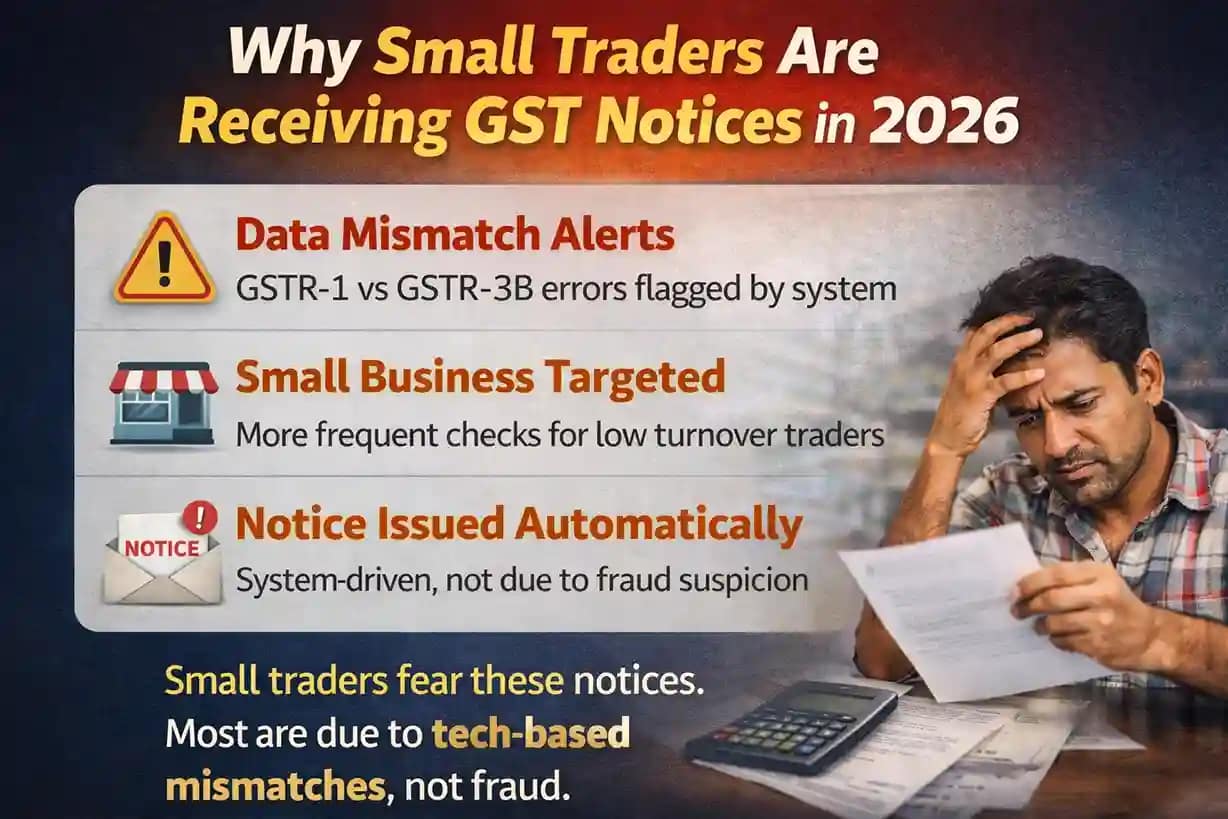
GSTR-1 vs GSTR-3B
-
ITC claimed vs supplier-reported data
-
Turnover declared vs income-tax records
-
Bank account and PAN linkage details
Even a small mismatch, which earlier might have gone unnoticed, is now picked up instantly by the system.
Once flagged, the case moves to scrutiny — and a notice may be issued.
It is important to understand that this process is system-driven, not personal. In most cases, there is no suspicion of fraud.
Who Is Most at Risk in 2026
Based on recent practical cases, notices are more common among:
-
Businesses with nil or very low turnover
-
Traders making frequent corrections or revisions
-
Dealers unaware of GSTR-1 and GSTR-3B matching rules
Many of these traders are otherwise honest and compliant.
The issue is usually data inconsistency, not tax evasion.
A Common Mistake Seen on the Ground
A trader files GSTR-3B correctly and pays tax on time.
However, a small invoice entry mistake is made while filing GSTR-1.
The difference looks insignificant and is ignored.
Months later, the GST system matches the data, detects the mismatch, and flags the case.
The trader then receives a notice asking for clarification — even though tax was already paid.
This situation is becoming increasingly common in 2026.
Why This Is Creating Fear Among Small Traders
GST notices create fear because:
-
The language used is technical
-
Reply timelines are short
-
Traders immediately assume heavy penalty or cancellation risk
In reality, many notices are clarification-based, meant to seek explanation or correction.
However, ignoring or delaying a reply can escalate the issue unnecessarily.
CA’s Practical Advice (Very Important)
As a practicing Chartered Accountant, I regularly see traders panic the moment a GST notice arrives. In most cases, the problem is solvable with a proper reply and documentation.
The most common misunderstanding I hear is:
“If tax is paid, nothing can go wrong.”
In today’s GST environment, data accuracy matters as much as tax payment.
The system does not judge intent — it only compares numbers.
What You Should Do Immediately If You Receive a Notice
-
Read the notice calmly — don’t panic
-
Check GSTR-1 and GSTR-3B for mismatches
-
Review ITC claimed vs purchase data
-
Respond within the given deadline
-
Take professional advice if the issue is unclear
In most cases, timely and correct response prevents penalties.
Final Word for Small Traders
GST compliance in 2026 is system-controlled and data-driven.
Even honest mistakes can trigger notices if numbers do not match perfectly.
The good news is — most issues can be corrected if handled properly and on time.
Being alert, checking data regularly, and responding calmly is now a part of running a compliant business.
1 thought on “Many Small Traders Getting GST Notices in 2026 – CA Explains the Real Reason”