
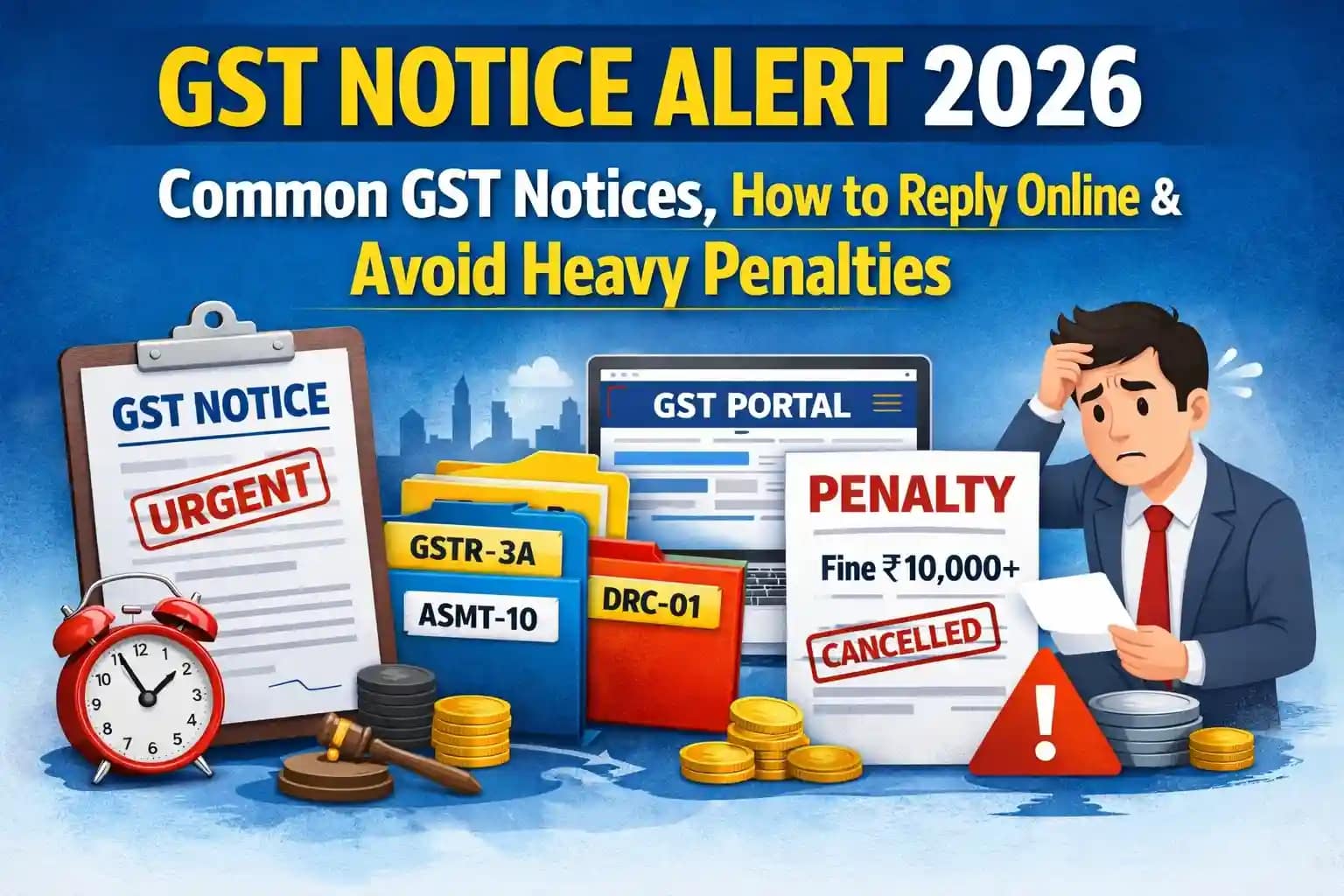
GST Notice Alert 2026: Common GST Notices, How to Reply Online & Avoid Heavy Penalties
Receiving a GST notice is one of the most stressful moments for any business owner. Whether you are a trader, manufacturer, service provider, or startup founder, the moment a GST notice appears on the portal or email, questions start coming in mind — Why did I receive this notice? What penalty will apply? How do I reply online?
With increased use of data analytics and return matching, GST Notice Alert 2026 has become a serious compliance issue for Indian businesses. The good news is that most GST notices can be handled safely if you understand the notice type, reply time limit, and correct response process.
This article explains common GST notices in India, the GST notice reply online process, how to reply GST notice online, GST notice penalty rules, and what to do immediately when a GST notice is received.
What Is GST Notice Alert 2026?
GST notice alert 2026 refers to the growing number of notices issued by GST authorities due to stricter compliance checks. These notices are generated when the system finds inconsistencies in returns, payments, registrations, or input tax credit claims.
A GST notice is not always a tax demand. In many cases, it is simply a request for clarification, additional documents, or correction of errors.
The key reason behind the rise in GST notices is:
-
Automated scrutiny of GSTR-1, GSTR-3B, and GSTR-2B
-
AI-based risk assessment
-
Vendor compliance tracking
-
Cross-verification with e-way bills, ICEGATE, and income tax data
GST Notice Received – What to Do Immediately?
If you have received a GST notice, the first rule is do not panic and do not ignore it.
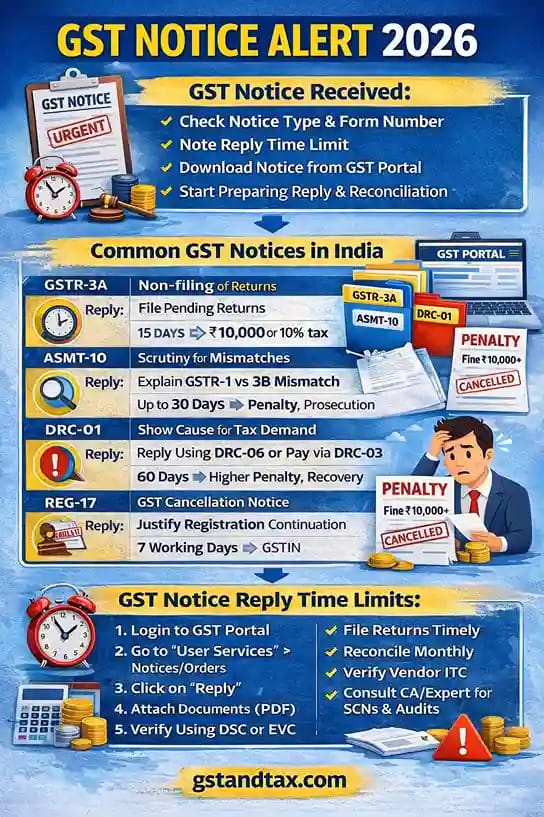
You should immediately:
-
Check the form number of the notice
-
Read the reason mentioned carefully
-
Note the GST notice reply time limit
-
Download the notice from the GST portal
-
Start preparing reconciliation and documents
Ignoring a GST notice can result in penalties, recovery proceedings, or cancellation of GST registration.
Common GST Notices in India (Most Issued in 2026)
Below are the most common GST notices in India along with their purpose, reply action, and consequences. These notices account for almost all notices issued to businesses.
GSTR-3A – Default Notice for Non-Filing
Issued when GST returns like GSTR-1, GSTR-3B, or GSTR-4 are not filed.
The taxpayer must file pending returns with late fees and interest within 15 days.
If ignored, the department can assess tax on a best-judgment basis and impose a penalty of ₹10,000 or 10% of tax due, whichever is higher.
ASMT-10 – Scrutiny Notice
Issued when discrepancies are found between GST returns.
The taxpayer must reply in ASMT-11 explaining mismatches with proper reconciliation.
Failure to reply may lead to tax demand, penalty, and prosecution.
DRC-01 – Show Cause Notice for Tax Demand
Issued when tax is unpaid, short-paid, or wrongly refunded.
Reply is submitted using DRC-06 or voluntary payment via DRC-03.
Non-response may result in recovery proceedings, higher penalty, and attachment of property.
REG-03 – GST Registration Clarification
Issued during registration or amendment when documents are incomplete.
Reply must be submitted in REG-04 within 7 working days.
If ignored, GST registration application may be rejected.
REG-17 – GST Cancellation Notice
Issued when authorities propose cancellation of GST registration.
Reply is required in REG-18.
Failure results in cancellation of GST registration, impacting business operations.
RFD-08 – GST Refund Notice
Issued when refund is proposed to be rejected.
Reply in RFD-09 with supporting documents is required.
Non-reply results in refund rejection.
Most Common Reasons for GST Notices
Understanding the cause helps in drafting an accurate reply.
The most common reasons include:
-
Mismatch between GSTR-1 and GSTR-3B
-
ITC difference between GSTR-3B and GSTR-2B
-
Continuous late filing of returns
-
Excess or ineligible ITC claim
-
Non-registration under GST
-
E-way bill mismatch
-
Export data mismatch with ICEGATE
-
Anti-profiteering complaints
-
Audit or information-seeking proceedings
GST Notice Reply Online Process (Step-by-Step)
The GST notice reply online process is fully digital and must be followed carefully.
To reply GST notice online:
-
Login to the GST portal using your credentials
-
Go to Services → User Services → View Additional Notices/Orders
-
Open the notice and read the observations carefully
-
Click on the Reply option
-
Upload a properly drafted reply letter and supporting documents
-
Verify submission using DSC or EVC
-
Submit and save the acknowledgment
After submission, the portal will show “Reply filed by taxpayer”.
Also Read:-https://gstandtax.com/gold-silver-taxation-in-india-2026-buying-selling/

How to Reply GST Notice Online Correctly
While replying online, ensure that:
-
Reply is clear and point-wise
-
All discrepancies are explained logically
-
Supporting documents are attached
-
Reconciliation statements are included
-
Reply is filed within the time limit
A vague or delayed reply can weaken your case.
GST Notice Reply Format (Simple & Practical)
A proper GST notice reply format improves acceptance chances.
Your reply should include:
-
Reference to notice number and date
-
Section under which notice is issued
-
Explanation for each issue raised
-
List of documents attached
-
Request for closure of proceedings
Avoid emotional or argumentative language. Always stick to facts and compliance records.
GST Notice Reply Time Limit
Every GST notice specifies a deadline. The GST notice reply time limit may be:
-
7 working days
-
15 days
-
30 days
-
60 days (mainly for DRC-01)
Missing the deadline allows the department to pass an order without considering your reply.
GST Notice Penalty Rules (2026)
Penalties depend on the nature of default.
Common penalties include:
-
Late fee of ₹50 per day (₹20 for NIL returns)
-
Interest at 18% or 24% per annum
-
Penalty of ₹10,000 or 10% of tax due
-
100% penalty in fraud cases
-
Cancellation of GST registration
-
Recovery proceedings and attachment of assets
How to Avoid Heavy GST Penalties
To stay safe from GST notices and penalties:
-
File GSTR-1 and GSTR-3B on time
-
Reconcile returns monthly with GSTR-2B
-
Monitor vendor compliance
-
Maintain GST records for at least 6 years
-
Respond promptly to all notices
-
Seek professional help for complex cases

Can a Chartered Accountant Reply on Your Behalf?
Yes. A taxpayer can authorize a Chartered Accountant or GST practitioner to reply to GST notices. This is highly recommended for scrutiny notices, show cause notices, audits, and large tax demands.
Final Conclusion
A GST notice does not automatically mean penalty or fraud. In most cases, it is a compliance reminder.
If you clearly understand:
-
GST notice alert 2026
-
Common GST notices in India
-
How to reply GST notice online
-
GST notice reply format
-
GST notice reply time limit
-
GST notice penalty rules
you can protect your business from unnecessary penalties and legal trouble.
The key is timely action, accurate reply, and proper documentation.