
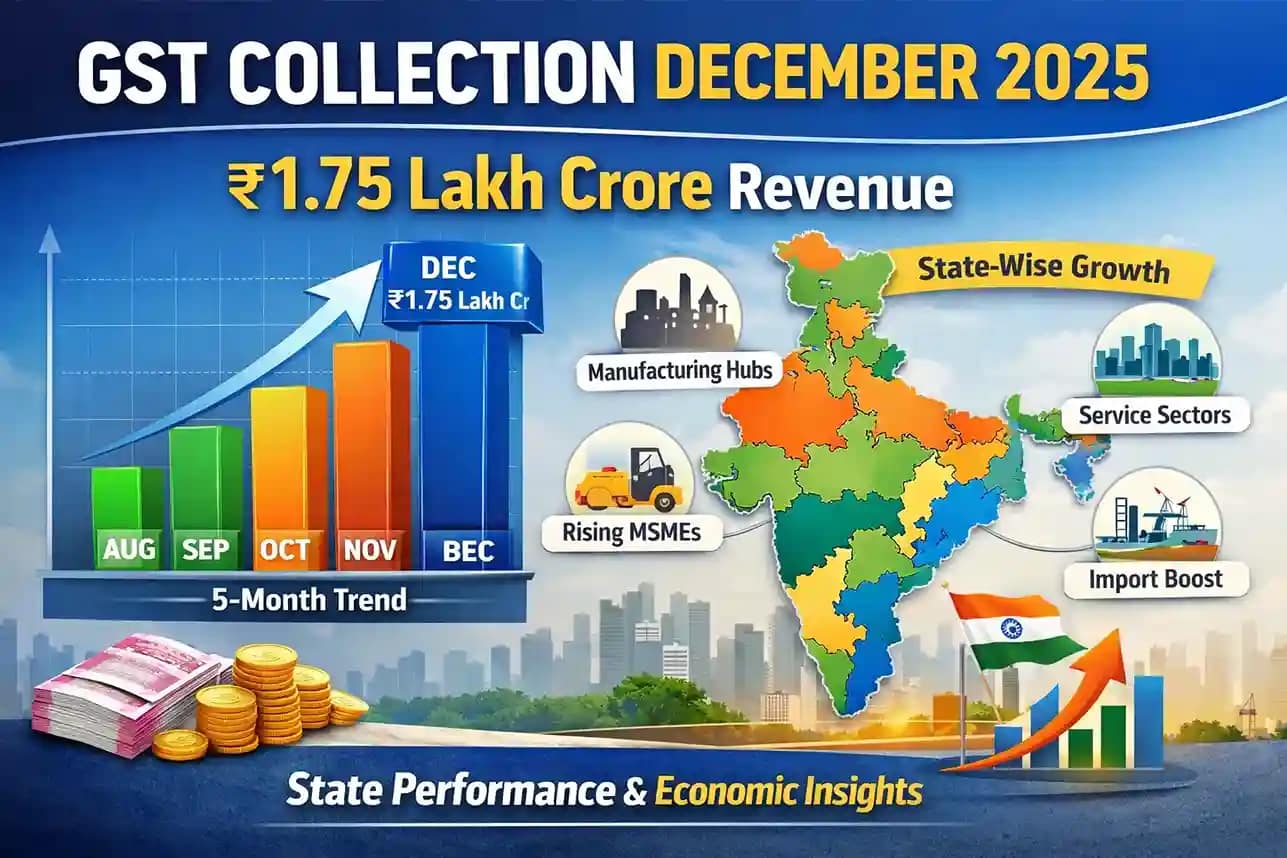
GST collection December 2025 has once again highlighted the resilience of India’s economy, with gross GST revenue touching ₹1.75 lakh crore and registering a 6.1% year-on-year growth. The latest figures indicate stable consumption demand, improved compliance, and balanced state-wise contribution across major economic regions.

GST Collection Trend: August–December 2025
| Month | Gross Collection | Trend Note |
|---|---|---|
| Dec 2025 | ₹1.75 Lakh Cr | Year-end demand + import revenue surge |
| Nov 2025 | ₹1.70 Lakh Cr | Stabilization after reforms |
| Oct 2025 | ₹1.96 Lakh Cr | Festive season peak |
| Sep 2025 | ₹1.89 Lakh Cr | First month post GST 2.0 rate changes |
| Aug 2025 | ₹1.86 Lakh Cr | Steady industrial growth |
Key takeaway: GST receipts remained above ₹1.70 lakh crore for five consecutive months, with October making a peak due to festive demand, and December showing quality growth backed by imports and business activity.
The GST collection December 2025 trend clearly indicates improving tax compliance and steady consumption demand across multiple states.
Gross vs Net Collections
Gross GST (before refunds): ₹1,74,550 crore, up 6.1% YoY.
Net GST (after refunds): ₹1,45,570 crore, up ~2.2% YoY.
Refunds issued in December 2025 were about ₹28,980 crore, significantly higher than the previous year, reflecting faster processing and strong export-linked claims.
Where Growth Came From
GST from imports recorded a robust increase (~19.7%).
Domestic GST showed marginal growth (~1.2%).
This mix shows that while local demand remains stable, global trade activity and inbound services/commodities also boosted the tax collections.
Cumulative GST Till Dec 2025
The GST collection December 2025 data also shows that revenue stability has improved compared to previous years, reducing dependence on festive-season spikes alone.
For the Apr–Dec 2025 period, total GST revenue stood at around ₹16.50 lakh crore, registering ~8.6% growth compared with the same period last year.
This cumulative data confirms sustained buoyancy even after major GST rate cuts that took effect earlier in FY26 under GST 2.0.
Also Read:-https://gstandtax.com/gst-for-exporters-zero-rated-supplies-documentation/

State-Wise GST Performance (December 2025)
According to official breakdowns:
Top Performers (High contribution + growth):
Maharashtra: ~15% SGST growth
Haryana: ~16% growth
Gujarat: ~12% growth
Tamil Nadu: ~8% growth
Karnataka: ~5% growth
Emerging States:
Smaller states like Arunachal Pradesh, Meghalaya, and Nagaland reported high percentage growth, indicating improving compliance and widening tax base.
Trend Insight:
States with large service sectors (like Maharashtra and Karnataka) and manufacturing hubs (like Gujarat and Tamil Nadu) continued to contribute a significant share, while smaller states are gradually catching up.
Regional GST Patterns: What State-Wise Data Really Indicates
A closer look at state-wise GST collection trends for December 2025 reveals an important shift in India’s revenue dynamics. While traditionally dominant states such as Maharashtra, Gujarat, Tamil Nadu, and Karnataka continue to contribute a significant share of GST revenue, the growth momentum is no longer limited to a handful of industrial hubs.
Several consumption-driven states have shown consistent improvement in GST collections, reflecting rising formalization of local businesses, better return filing discipline, and increased digital compliance. States with expanding logistics networks, infrastructure projects, and MSME activity have particularly benefited from GST system improvements, including e-invoicing and real-time data matching.
Another notable trend is the narrowing gap between manufacturing-led and services-led states. Service-heavy regions are witnessing stronger GST inflows due to higher tax compliance in sectors such as IT services, hospitality, transport, and professional services. At the same time, manufacturing-oriented states continue to benefit from steady domestic demand and improved supply chain efficiency.
Overall, the state-wise GST data for December 2025 highlights a more balanced and inclusive growth pattern. Instead of relying on festive-driven spikes alone, GST collections are increasingly being supported by sustained economic activity across regions. This broad-based contribution strengthens the overall stability of India’s indirect tax framework and reduces over-dependence on a few high-revenue states.
What Is Driving GST Growth?
1. GST 2.0 Simplification
GST rate rationalization in September 2025 streamlined slabs and encouraged compliance.
2. Import-Driven Revenues
Higher tax collections from imported goods and services helped cushion slower domestic growth.
3. Refund Efficiency
Faster refund processing improved taxpayer confidence and liquidity in the system.
4. Increased GSTIN Base
Registered taxpayers exceeded 92 lakh, indicating continued formalization of the economy.
What This Means for the Economy
Strong fiscal inflows support government spending on infrastructure and social programs.
Stable GST growth despite rate cuts suggests a resilient tax administration.
Balanced contributions from states point to equitable economic recovery across India.
Analysts believe that GST collection December 2025 reflects structural strength rather than seasonal volatility.
Dec 2025’s GST numbers signal not just a year-end revenue spike but a structural strengthening of indirect tax collections.
Outlook for Early 2026
As economic activity normalizes post-festive season and international trade patterns settle, analysts expect:
Continued GST collections above ₹1.6–1.7 lakh crore monthly.
Export and import dynamics to remain key drivers.
States with robust industrial activity to lead growth.Overall, GST collection December 2025 confirms that India’s indirect tax system is moving toward predictable and sustainable growth.
Summary
GST collections rose to ₹1.75 lakh crore in December 2025 with 6.1% growth.
Net collections remained strong after refunds.
Maharashtra, Haryana, Gujarat were key growth contributors.
Cumulative GST for Apr–Dec 2025 grew ~8.6%.
Overall, GST collection December 2025 reinforces confidence in India’s indirect tax framework and long-term revenue stability.